
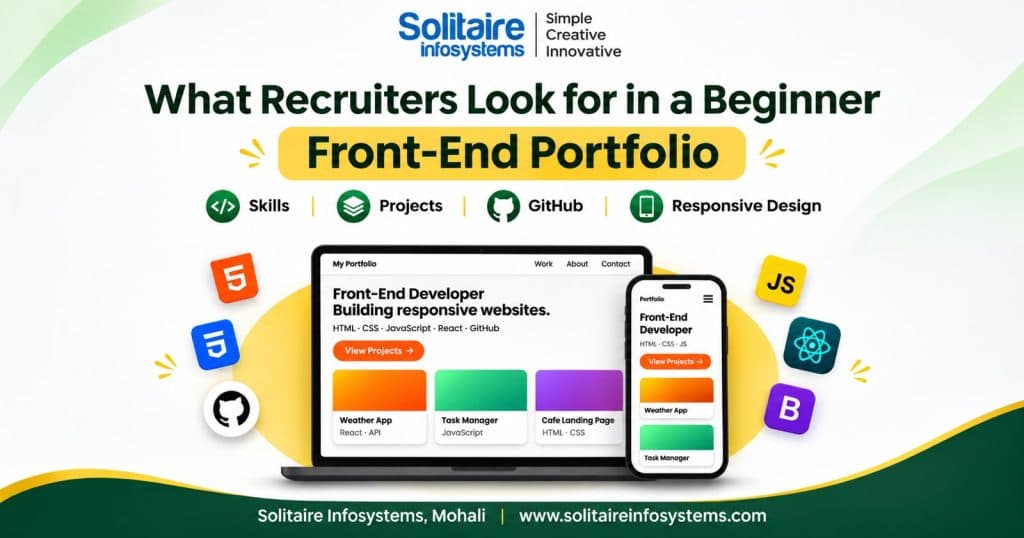
Beginner Front-End Portfolio: What Recruiters Actually Look For
Recruiters reviewing a beginner front-end portfolio check five things: solid HTML, CSS and JavaScript fundamentals, three to five working projects, responsive design, clean code on GitHub with live links, and whether you can explain how you built each project. They don’t expect years of experience or fancy design. They want proof you can build something that works.
Here’s what each of those looks like in practice, plus the mistakes that get fresher portfolios skipped.
What skills should a beginner front-end portfolio prove?
The basics, done properly. Your projects should show you can use:
- HTML: well-structured pages with the right elements (header, nav, main, section, button) rather than divs everywhere
- CSS: layouts, spacing, colour and consistent component styling
- JavaScript: handling clicks and form input, updating the page, and working with simple data
If you list Bootstrap or React, there should be a project that uses it. Recruiters often ask about the last item on your skills list first.
Which projects should a fresher add to a front-end portfolio?
Working projects beat certificates and screenshots every time. Good beginner choices:
- Personal portfolio website: the portfolio itself is your first project
- Restaurant or local business website: menu, contact details and responsive navigation
- To-do list app: add, delete and filter tasks, ideally saved in localStorage
- E-commerce product page: product cards, pricing and interactive buttons such as add to cart
Three to five well-built projects make a stronger impression than ten incomplete ones. One honest opinion: make at least one project something nobody gave you as a tutorial, even a small one. That’s the project interviewers ask the most about.
Does your portfolio need to be responsive?
Yes. Recruiters will open your link on a phone, and a broken mobile layout is often the first reason a portfolio gets closed. Every project should:
- Adjust properly to phone, tablet and desktop widths
- Have navigation that works on mobile
- Show images without stretching or distortion
- Keep text readable with enough spacing
Use Flexbox, CSS Grid and media queries, and test on a real phone before you share the link. Browser developer tools help, but they don’t catch everything.
How do recruiters judge your code?
Many will open your GitHub repository. They look for:
- Meaningful file and folder names
- Consistent indentation
- Reusable CSS classes instead of repeated styles
- Small, clearly named JavaScript functions
- No leftover commented-out code or unused files
Add a README to every project explaining what it does, which technologies you used and how to run it. It takes ten minutes and immediately makes the project look finished.
What should each GitHub project include?
- Project name and a one-line description
- Technologies used
- Source code repository
- Live website link
- Screenshots where they help
Free hosting such as GitHub Pages or Netlify lets you publish projects in minutes. A live link means a recruiter can see the result without downloading anything, and many won’t bother if they have to.
Does design matter in a front-end developer portfolio for freshers?
Usability matters more than visual flair. Recruiters notice consistent fonts and colours, proper alignment, navigation that makes sense, buttons and links that work, and readable content. Basic accessibility counts too: alt text on images, enough colour contrast and labels on form fields. The W3C’s introduction to web accessibility is a good place to start.
Skip heavy animations and extra colours. A simple design that works properly comes across as more professional than a busy one.
How do you show problem-solving as a beginner?
Be ready to talk through any project. For a responsive restaurant website, you should be able to answer:
- Why did you choose that layout?
- How did you make it work on mobile?
- Which bug took you the longest, and how did you fix it?
- What would you improve in the next version?
Clear answers show you understand your work rather than copying from tutorials. This is where many freshers lose interviews, even with good-looking projects.
What sections should the portfolio website have?
| Section | What to include |
| About | Two or three lines on who you are and why front-end development |
| Skills | Only technologies you can explain in an interview |
| Projects | Best 3–5 projects with descriptions, live links and GitHub links |
| Resume | View or download option, kept up to date |
| Contact | Professional email address and LinkedIn/GitHub profiles |
What mistakes make recruiters skip a fresher’s portfolio?
These are the ones our trainers see most often when reviewing student portfolios:
- Projects that were never tested, with broken links or buttons that do nothing
- Copied designs the student can’t explain line by line
- Skills listed that the student hasn’t actually used
- The same generic description pasted under every project
- Layouts that break on mobile
- Too much content, so the projects are hard to find
Before sharing your link, open it on your phone, click every button, and read each description out loud. Honest, working projects beat an impressive-looking skills list.
How can front-end training help you build a better portfolio?
Building alone, it’s easy to stall on tutorials or never finish a project. Structured training gives you deadlines, code reviews and a project scope that looks like real work. At Solitaire Infosystems in Mohali, students build responsive layouts, JavaScript features and React projects as part of the 6 months web development training, with a mentor reviewing their code along the way.
Students who also need university training credit can do this through 6 months industrial training in Mohali or a 6 months internship; 6-week training and stipend-based internships are also available.
Frequently asked questions
What should a beginner front-end portfolio include?
An About section, the skills you can actually explain, three to five working projects with live links and GitHub repositories, a resume, and contact details. Each project should have a short description of what it does and what you used to build it.
How many projects should a fresher put in a front-end portfolio?
Three to five well-built projects is a good number. Recruiters prefer a few complete, responsive projects over ten unfinished ones.
Is GitHub important for front-end developers?
Yes. GitHub lets recruiters see your code, how you organize files and how often you commit. A clean README on each project makes a noticeable difference.
Can I get a front-end developer job without work experience?
Yes. For entry-level roles, recruiters judge freshers on projects, fundamentals and how clearly they explain their work. A strong portfolio is how you show that.
Should beginners learn React before building a portfolio?
No. Build your first projects in HTML, CSS and JavaScript. Once those are solid, learn React and add one or two React projects to show progression.
Build your portfolio with real project work
See modules, duration and batch dates for web development training at Solitaire Infosystems, or talk to a counsellor.
Call: +91 98766 56700
Email: info@solitaireinfosystems.com
Visit: Solitaire Infosystems, C-110, Phase 7, Industrial Area, Mohali, Punjab (contact and directions)